Hammel Houses sits a couple blocks from the ocean in the Rockaways on land that used to be a summer resort with hotels and a steamboat dock. How it went from one to the other is not really a story about the Rockaways at all, it’s a story about decisions made in Manhattan about where the city’s poorest residents should be put.
Who Louis Hammel Was
The neighborhood and the development both take their name from Louis Hammel, a German immigrant born in 1836 who came to the United States and spent his summers running the Eldert House hotel out on the peninsula. The area had started in the 1850s as a chowder house and saloon that grew into Eldert’s Grove, a hotel and restaurant, which Hammel leased in 1869. He then bought land nearby and put up Hammel’s Hotel along with a steamboat dock running out to Jamaica Bay.
In 1878 he gave land to the New York, Woodhaven and Rockaway Railroad so they could build a station, and they named it Hammels. He died in 1904 and the name outlived him by a long stretch.
The Resort Years
What Hammel built was a whole summer economy. Hammels ran on a series of boardwalks connecting the bay side to the ocean side, and the broader Rockaway peninsula spent decades as a genuine destination, sometimes called the Queens Riviera. Bungalow colonies covered a lot of the land, built for people who came out from the city for the season.
What Changed
By the 1950s and 60s the peninsula was going through several things at once. White first and second generation families were doing well enough to leave the city, the bungalow areas were being classified as slums, and Robert Moses brought urban renewal to the Rockaways using Title I money from the federal Housing Act of 1949.
The results are not really in dispute. Land out there was cheap and available so the peninsula got treated as a place to put things, and large scale public housing went up on a scale that had no relationship to the surrounding population. Rockaway Park ended up holding over half of all the public housing in Queens while containing a small fraction of the borough’s residents. The developments were built dense, with very little retail options planned around them, and they were filled largely with people of color who had been displaced from elsewhere in the city.
That’s the part worth stating plainly. The people with the fewest resources were moved about as far from jobs, transit, and services as it was possible to go while remaining inside city limits.
What Hammel Houses Actually Is
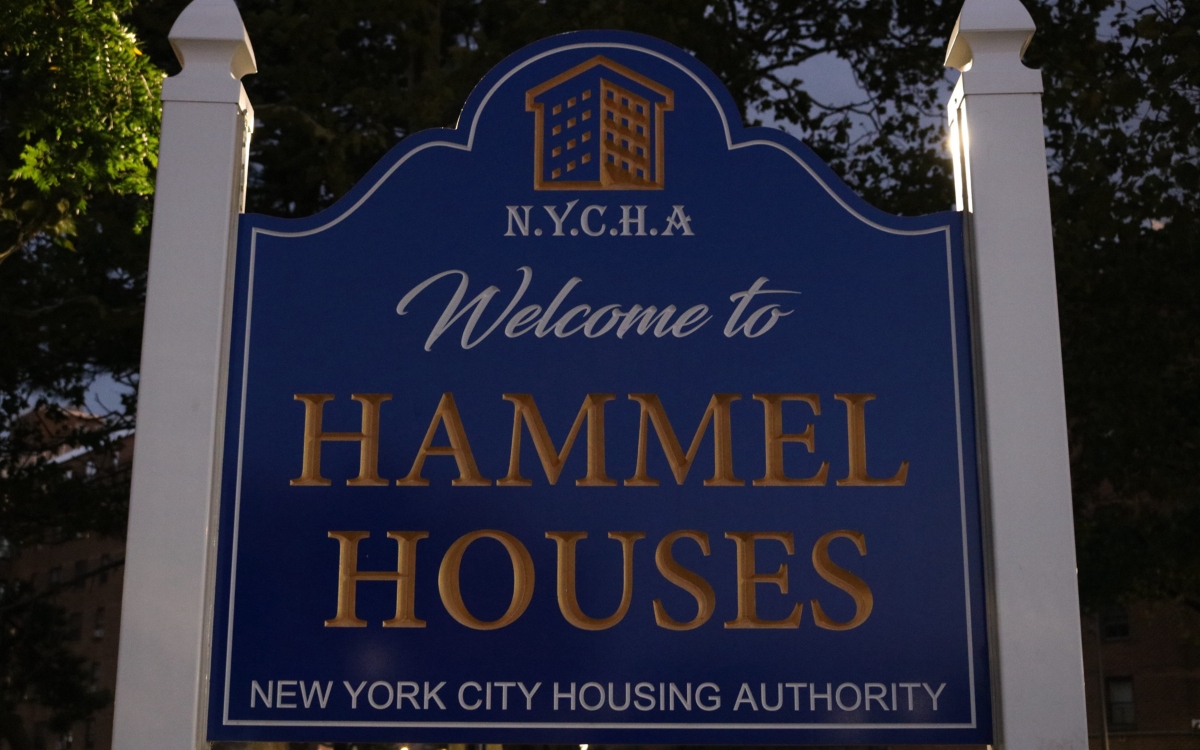
Hammel Houses was completed on April 30, 1955 across roughly 14 acres bordered by Beach 81st and Beach 86th Streets and by Hammels and Rockaway Beach Boulevards. It runs 14 buildings of six and seven stories with 712 apartments and close to 2,000 residents.
Where Things Stand Now
Everything that makes the Rockaways difficult to live in has compounded since. The peninsula is a long commute from most of the city, the retail base has never been what a population that size needs, and the entire area sits directly in the path of coastal storms, which Hurricane Sandy demonstrated in 2012 as it wrecked havoc across every development out there.
Seventy years after it opened, Hammel Houses is dealing with the same aging systems as the rest of NYCHA, plus the specific vulnerabilities of being a few hundred feet from the Atlantic Ocean. The resort that Louis Hammel spent his life building is long gone and what replaced it was never designed with the people living there in mind.
Still they continue to find a to continue to thrive, despite the odds.